
From a Living Room to a $26.2 Billion Deal: The LinkedIn Story
The hook: one idea that changed careers
One man believed that changing the world didn't require becoming a professor. Sometimes, building a software platform could have a much greater impact on millions of lives.
His name was Reid Hoffman.
His idea was simple: what if every professional's identity, skills, experience and connections could live in one place? What if finding career opportunities became easier for everyone?
Today, we know that idea as LinkedIn.
But here's the interesting part. LinkedIn's journey to becoming a $26.2 billion business didn't begin with success. It began with failure.
Chapter 1: Learning from failure
Reid Hoffman studied Symbolic Systems at Stanford University and Philosophy at Oxford, and he initially wanted an academic career. Then he realised something important: a research paper might reach a few thousand readers, but a software platform could influence millions.
In 1994, he worked on Apple's eWorld project. He later gained experience at Fujitsu and launched his first startup, SocialNet, in 1997. It aimed to connect people through dating, shared interests and roommate discovery.
The business struggled. Internet adoption was still limited, people weren't comfortable sharing their identities online, and the product tried to solve too many problems at once.
Reid took away a crucial lesson: a good idea isn't enough. You need the right market, the right timing and a clear problem to solve.
He then joined PayPal, where he saw first-hand how to deal with fraud, financial regulation and the challenge of scaling a technology company. In 2002, eBay acquired PayPal for approximately $1.5 billion. Reid now had capital, experience and a powerful network of entrepreneurs, and he was ready to build something new.
Jora Capital takeaway: Failure isn't the opposite of success. It's often the tuition fee for it.
Chapter 2: The birth of LinkedIn
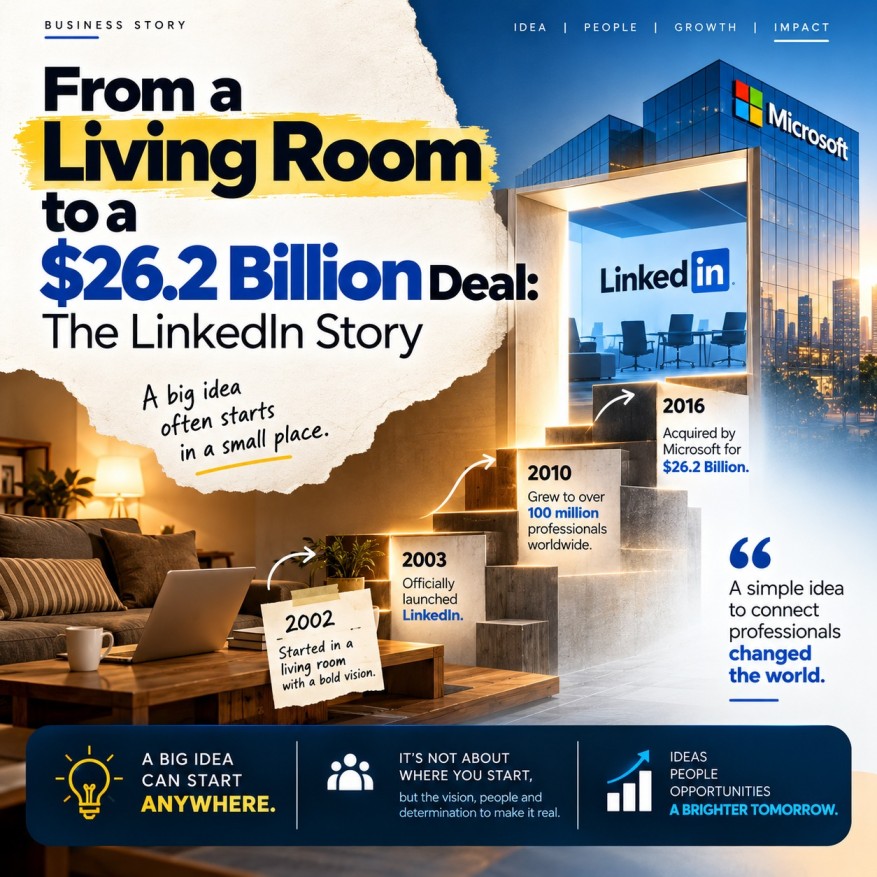
In December 2002, Reid assembled a team in his living room in Mountain View, California. His co-founders included Allen Blue, Konstantin Guericke, Eric Ly and Jean-Luc Vaillant.
On May 5, 2003, LinkedIn officially launched. And there was a problem: only around 4,500 members joined in the first month.
Imagine launching a networking platform when almost nobody is on it. No meaningful connections, few opportunities and little reason for anyone to sign up. In business, this is called the cold-start problem.
Reid didn't try to attract everyone at once. LinkedIn focused on a small but highly connected community: technology professionals, executives, investors and entrepreneurs in Silicon Valley. The platform emphasised real names, authentic professional identities and genuine work experience.
Then came a crucial growth feature: importing email contacts. Instead of finding every professional one by one, users could invite people from their existing address books. One person invited ten. Those ten invited more. The network grew through its own connections.
By the end of 2003, LinkedIn had around 81,000 members. In November 2003, Sequoia Capital led a $4.7 million Series A round, and in 2004 Greylock Partners added another $10 million.
Reid's strategy was simple: build the network first, monetise it later.
Jora Capital takeaway: Start small, focus on the right people and build trust before you build revenue.
Chapter 3: How did LinkedIn make money?
Here's the big question. If LinkedIn was free to use, how would it earn revenue? Reid's team identified three big opportunities:
1. Talent Solutions: Companies need access to qualified professionals, including people who aren't actively job-hunting. LinkedIn Recruiter helped employers find and reach them.
2. Marketing Solutions: Businesses could advertise to specific professional audiences by industry, job title, company size and seniority.
3. Premium Subscriptions and Sales Solutions: Professionals and sales teams could pay for advanced search, extra communication features and tools such as Sales Navigator.
Recruiters needed talent. Businesses needed customers. Salespeople needed leads. LinkedIn had built a network that could serve all three.
Instead of depending only on ads, LinkedIn built several revenue streams by solving expensive business problems. By March 2006, it recorded its first month of operational profitability. It was no longer just a social network. It was a serious business.
Jora Capital takeaway: Real businesses solve costly problems. Users matter, but value creation is what keeps a company alive.
Chapter 4: When growth became a technical problem
As LinkedIn grew, technology became a challenge. It originally ran on a single large Java application known internally as Project Leo, which handled web pages, business logic and database interactions.
That worked for a startup. But as millions of users created profiles, sent messages, searched for jobs and built connections, the system strained. A failure in one part could affect the whole platform.
The engineering team moved towards microservices and more scalable distributed systems. One major innovation emerged from these infrastructure problems: Apache Kafka. Engineers Jay Kreps, Neha Narkhede and Jun Rao built it so different systems could exchange data reliably. Instead of wiring every system to every other, applications publish events to a shared streaming platform and others consume them.
LinkedIn open-sourced Kafka in 2011, and its creators later founded Confluent, a company built around data-streaming technology.
Jora Capital takeaway: Solve your own problem well enough, and the solution may become valuable to an entire industry.
Chapter 5: The financial architect
Another key figure was Steve Sordello, who joined LinkedIn as Chief Financial Officer in July 2007. At the time, the company had about 100 employees, 10 million members and $15 million in annual revenue.
Turning a fast-growing startup into a global business takes more than users and engineers. It takes financial discipline, reliable accounting, budgeting, compliance and the ability to allocate capital wisely. Sordello helped build that foundation and prepare the company for the public markets.
On May 19, 2011, LinkedIn went public on the New York Stock Exchange at $45 per share. On its first trading day, the stock closed at about $94.25, giving the company a market value of roughly $8.9 billion.
But the biggest financial twist was still ahead.
Jora Capital takeaway: Great products need great financial management behind them. Money discipline is a growth strategy.
Chapter 6: The $26.2 billion acquisition
In February 2016, LinkedIn disappointed investors with its revenue outlook. On February 5, its stock fell by about 43.6% in a single trading session, and people began to question whether the growth story was over.
But the difficult moment created an opportunity. Microsoft CEO Satya Nadella and LinkedIn's leadership began discussing how their businesses could work together. Microsoft had Office, Outlook and Azure. LinkedIn had a massive professional network connecting people, companies, jobs and skills. Salesforce also emerged as a competing bidder.
After months of negotiation, Microsoft offered $196 per share in cash. The acquisition was announced on June 13, 2016, at a total value of $26.2 billion, and it closed in December 2016.
The company Reid Hoffman started in a living room was now part of Microsoft's enterprise ecosystem. Not bad for a business that began with a few thousand users.
Jora Capital takeaway: Bad days in the market can open doors to the biggest opportunities.
Chapter 7: More than a jobs platform
Even after the acquisition, LinkedIn kept evolving. Its long-term ambition includes the Economic Graph, a digital map of relationships between professionals, companies, jobs, skills and educational institutions. Artificial intelligence and graph-based machine learning play a growing role. Where traditional search matches keywords, graph-based systems can also look at the relationships between people, skills, companies and opportunities, which can lead to more relevant recommendations.
But powerful data brings serious responsibility. LinkedIn has faced criticism and legal challenges around privacy, aggressive growth tactics and the use of publicly accessible profile data:
· The Perkins v. LinkedIn lawsuit concerned invitations and reminder emails sent through contact-import features. In 2015, LinkedIn agreed to a $13 million settlement.
· The company had a lengthy legal dispute with hiQ Labs over automated scraping of public profile information.
· Its expansion into China proved unsustainable amid regulation and strong local competition. In May 2023, LinkedIn announced the shutdown of its China-focused InCareer jobs app.
The lesson: data can be an extraordinary asset, but trust, consent and compliance matter just as much as growth.
Jora Capital takeaway: In finance and technology, trust is the product. Growth without trust doesn't last.
The real business lesson
LinkedIn's journey teaches three powerful lessons:
1. You don't always need to invent a new problem. Sometimes solving an existing problem much better is enough.
2. Users and revenue are not the same thing. A network is only step one. Creating economic value from it is what makes a business sustainable.
3. As a company grows, its technology, finances, leadership and responsibilities must grow with it.
Reid Hoffman brought the vision. Steve Sordello and other executives built the financial and operational foundations. Engineers created the infrastructure. And Microsoft carried LinkedIn into a broader enterprise ecosystem. Together, they transformed a small startup into a company acquired for $26.2 billion.
Because sometimes, the biggest business isn't the one selling everything itself.
It's the one connecting everyone else.
Join the Jora Capital journey
We're building Jora Capital with the same belief: clear, simple and trustworthy financial services, made for people. We share the real stories behind business, money and technology so you can learn, decide and grow with confidence.