
Settled vs Closed in CIBIL: What It Really Means for Your Credit Score
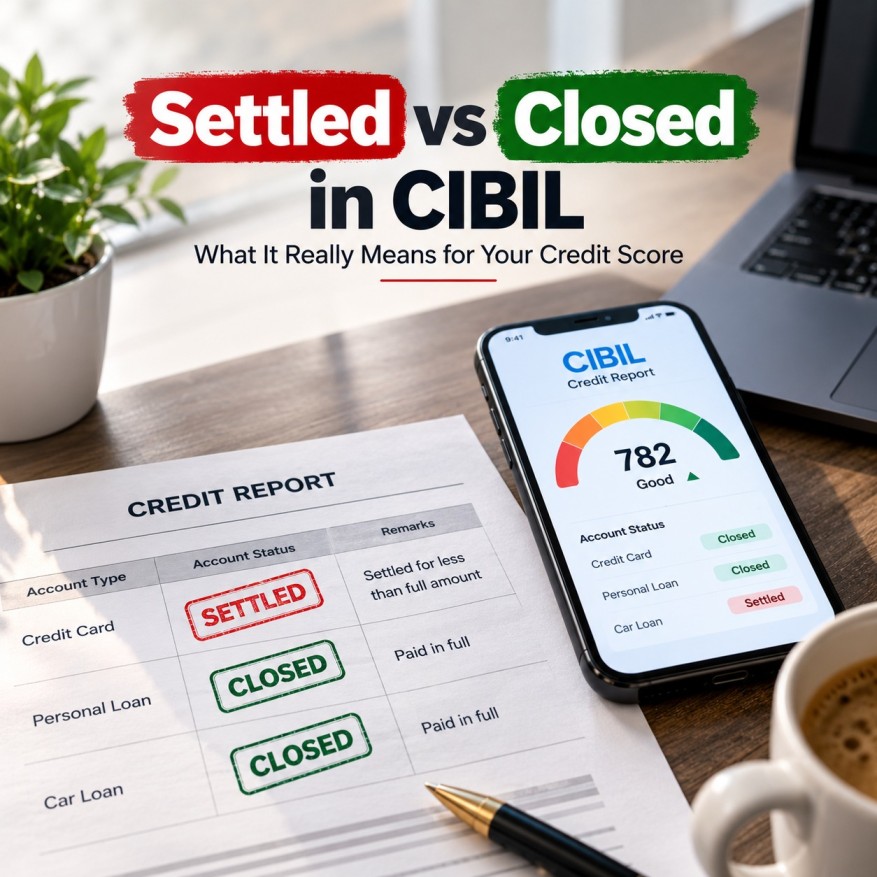
You finally cleared that old loan or credit card. The recovery calls stopped, the lender sent a letter, and you assumed your credit score would bounce back on its own. Months later, it hasn't moved, and your new loan application gets rejected.
If this sounds familiar, the culprit is usually one word on your CIBIL report: Settled.
At Jora Capital, we meet many borrowers who didn't know that how an account ends matters just as much as how it was managed. This guide explains the difference between Closed, Settled and Written Off accounts, how lenders see them, and how you can rebuild.
Closed vs Settled vs Written Off
Closed: the gold standard
A Closed account means you repaid everything you owed: principal, interest and any penalties. For a loan, that means the last EMI was paid or the loan was fully prepaid. For a credit card, it means you shut it with a zero balance. The lender usually issues a No Objection Certificate (NOC) or No Dues Certificate. Lenders read this status as neutral to positive, proof that you honour commitments.
Settled: partial payment, permanent mark
A Settled account means you were unable to repay in full, and the lender agreed to accept a smaller amount to close the matter. The rest was waived and booked by the lender as a loss.
The account is no longer active and collection stops, but the bureau record shows that the lender did not recover its full money. Instead of an NOC, you typically receive a settlement letter. This tag can stay on your report for up to seven years and weighs on your score throughout.
Written Off: the most serious tag
A Written Off status appears when a lender gives up on regular recovery after a long period of non-payment (typically 180+ days overdue) and removes the loan from its active books as a loss. This is an accounting action. It does not cancel your debt. The lender or an asset reconstruction company can still pursue recovery. Written-off tags can cause sharp score drops and make mainstream credit very hard to get.
If you later pay a reduced amount on a written-off account, it appears as Post Write-Off Settled. This is better than leaving it unresolved, but still a negative mark.
Quick comparison
|
Closed |
Settled |
Written Off |
Post Write-Off Settled |
|
|
What happened |
Paid in full |
Paid partially, rest waived |
Lender wrote it off as a loss |
Partial payment after write-off |
|
Lender's loss |
None |
Waived amount |
Entire balance |
Part of the balance |
|
Score impact |
Neutral to positive |
Significant negative |
Severe negative |
Severe negative |
|
Paperwork |
NOC / No Dues Certificate |
Settlement letter |
None |
Settlement letter |
|
Future credit |
Improves chances |
Tough, costly |
Very limited |
Very limited |
Why your score doesn't recover by itself
Scoring models see a settlement as a realised loss for the lender. Even though the account is no longer active, the record says you could not fulfil the original agreement.
When you apply for new credit, underwriters typically look at:
- Reason for default: Documented hardship such as a medical emergency or job loss is viewed more kindly than avoidance.
- How you handled it: Reaching out to the lender early looks better than going silent until recovery agents show up.
- Size and number of settlements: One small settlement in an otherwise clean profile is treated very differently from several across products.
- Secured or unsecured: Settling a home or auto loan is a bigger red flag than a small credit card settlement, since an asset was at stake.
- Recency: A settlement from six months ago hurts far more than one from three years ago.
- What you've done since: Clean repayments on other accounts, low card usage and few new applications all help.
A realistic timeline for getting credit again
Every lender is different, but this is a common pattern:
- 0 to 12 months: Prime unsecured loans are mostly out of reach. Focus on secured options like a card backed by a fixed deposit, to start building fresh positive history.
- 12 to 24 months: Some digital lenders may offer small loans at higher rates. Every payment must be on time.
- 24 to 36 months: Traditional lenders start to consider you, especially if your income has grown and your repayment record is spotless.
- Beyond 36 months: The settlement increasingly becomes old data, and recent behaviour drives decisions.
What RBI rules mean for you
Recent RBI changes have made the system fairer and faster:
- More frequent data updates: Lenders now report to credit bureaus far more often than the old monthly cycle, so good behaviour shows up sooner. The flip side is that a missed EMI shows up quickly too.
- 30-day dispute resolution: Under RBI's October 2023 circular, credit report disputes must be resolved within 30 days. Lenders get 21 days and bureaus get 9. If the deadline is missed, you're owed ₹100 per day in compensation.
- Cooling period after settlements: RBI's framework for compromise settlements and technical write-offs requires lenders to wait at least 12 months before extending fresh credit to such borrowers (for non-farm exposures).
- Short payout windows: If a settlement payout stretches beyond three months, it can be treated as a restructuring, which is why banks usually push for lump-sum settlements.
Can a Settled status become Closed?
Yes, but only one legitimate way exists: pay the amount that was waived. Credit bureaus only display what lenders report, so they can't change the status on their own. Here's the process:
- Ask the lender for the exact shortfall amount that was waived or written off.
- Pay it in full and keep the payment proof.
- Get a No Dues Certificate or closure letter from the lender.
- Raise a dispute on the CIBIL portal and attach the certificate, marking it as an account status error.
- Wait for verification. The lender confirms with the bureau within the 21-day window, and the bureau updates your report within 9 days.
Once updated, the account shows as Closed. This is especially useful for NRIs planning to return to India and apply for a home loan, as old settled accounts can surface at the worst time.
If you can't pay the shortfall: rebuild step by step
You can't change the history, but you can build a stronger present:
- Start with secured credit. An FD-backed credit card is one of the easiest ways to begin, since the deposit reduces the lender's risk.
- Keep usage below 30% of your limit, and pay the full bill on time every month.
- Never miss an EMI on any active loan. One late payment after a settlement undoes a lot of progress.
- Avoid applying everywhere. Many loan applications in a short time look like financial desperation.
- Check your CIBIL report regularly and dispute any wrong DPD or status entries.
- Be patient. Consistent behaviour over 24 to 36 months can steadily outweigh an old settlement.
A note on taxes
A waived loan amount can have tax implications, especially for business borrowers, and the rules have been changing. Before agreeing to a settlement, speak to a tax professional about how the waiver may be treated in your case.
The bottom line
Closed means you honoured the full agreement. Settled means the lender took a loss. That is why a settlement leaves a lasting mark, and why your score doesn't simply heal after the account ends. The good news is that faster reporting, clearer dispute rights and disciplined credit habits make recovery more achievable than ever.
Start rebuilding with Jora Capital
Whether you're recovering from a settlement or planning your next financial move, Jora Capital is here to help you take control of your credit journey.
- Download the Jora Capital app: Get it on Google Play
- Visit our website: joracapital.co